

Dear friends, do you, like me, consume high-calorie snacks and junk food every day, keep your fridge stocked with sugary sodas, and engage in no extra physical activity beyond necessary actions like going to work or school? If so, you might need to worry about your figure and seek a new lifestyle, much like the current trend popular on the international internet—#SkinnyTok.
"#SkinnyTok" seems like a coined word. The latter part, "Tok," represents its origin from TikTok, the overseas version of Douyin, while the first part, "Skinny," also has its nuances. We know that to describe someone as slim, we usually use "Slim" or "Slender," whereas "Skinny" often carries a hint of "pathology," similar to the Chinese phrase "bone-thin." However, the meaning of a word often changes with the times. Currently, on the international internet, there is indeed a group of people who pursue being "bone-thin" as their goal and share their weight-loss experiences everywhere, thus giving birth to "#SkinnyTok."
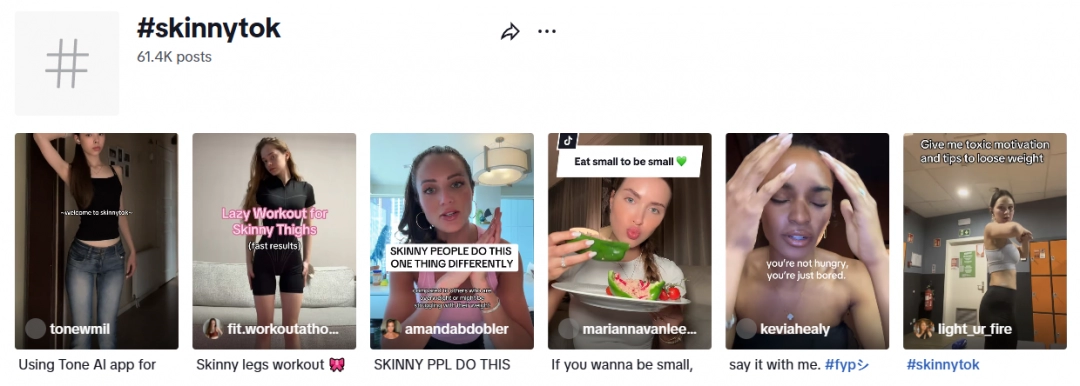
In their eyes, #SkinnyTok is a lifestyle that you must experience personally. First, get rid of those snacks and drinks, especially sugary sodas, which are calorie bombs. Foods that are not part of main meals are strictly prohibited, as they will only become obstacles on your weight-loss journey. If you want to lose weight, you don't need these useless pleasures.

Even main meals require careful consideration—What? You can't tell the difference between kilocalories, calories, and Calories? No problem. According to #SkinnyTok advocates: "If you want to lose weight, eat less; if you want to gain weight, eat more." If you find it difficult to determine what is reasonable to eat, then simply eat nothing at all—after all, in this case, the less you eat, the more weight you lose.
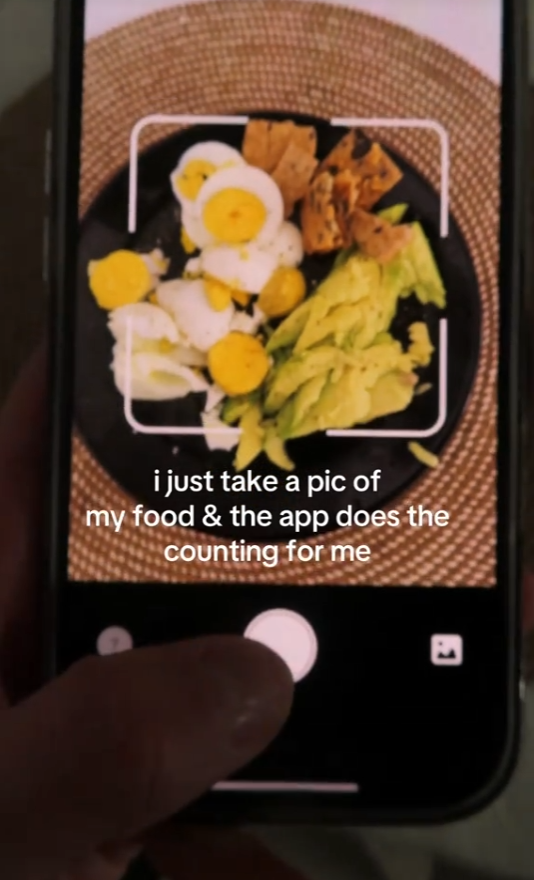
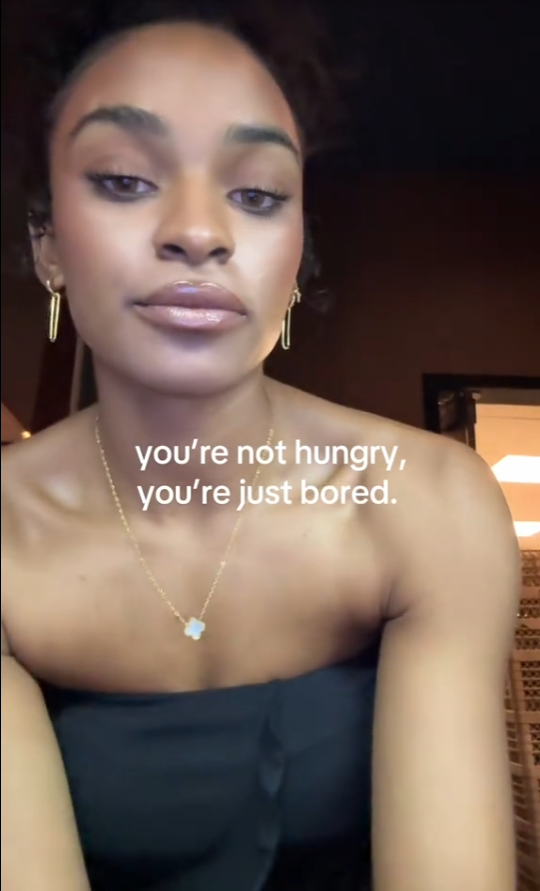
But in a situation where snacks are completely eliminated and main meals are restricted, what should you do when—actually, inevitably—you feel hungry? Should you look at pictures of food to satisfy your cravings? That would be a huge mistake. In the #SkinnyTok lifestyle, desensitization to food is essential. Here, whether it's snacks or main meals, they are merely external objects satisfying oral desires. You must follow the people in the videos and repeat "You're not hungry, you're just bored" more than ten times, firmly remembering that eating is a useless activity to kill time, thereby completely removing this action from your life. And thus, a wonderful life begins—look how happy she is smiling.
Finally, if you successfully develop anorexia or an eating disorder due to such practices, that would be even better—after all, this physiologically defines your behavior, allowing you to transition from experiencing #SkinnyTok to enjoying #SkinnyTok, feeling the ultimate pleasure of hunger.
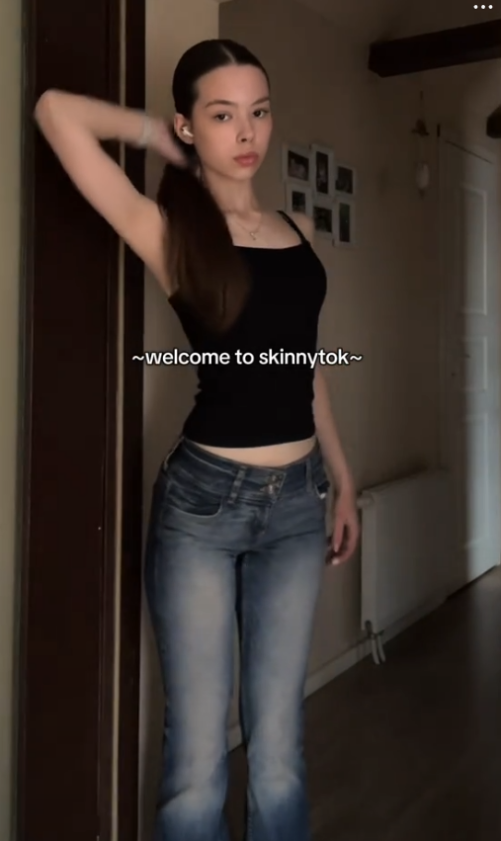
Readers might be wondering at this point: Is there really anyone who would disregard their own safety and risk their life just to lose weight this way? Yes, my friend. Yes. Not only are there many advocates for this behavior, but there are also countless imitators. On TikTok, #SkinnyTok has become a trending hashtag, with numerous influencers joining in, promoting the idea that "thin equals healthy" while actively practicing various weight-loss methods. Many others, believing these claims, have also joined the ranks of #SkinnyTok.
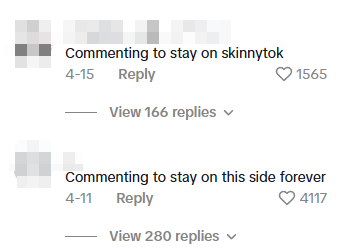
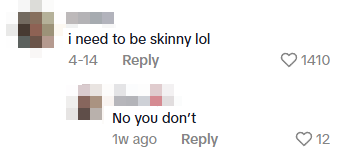
As you can see, check-in style comments are common in the comment sections of similar videos. Those who want to try or maintain this lifestyle leave comments and invite other like-minded weight-loss enthusiasts to join them. Although this may resemble a time-loop-style check-in where one constantly returns to Day 0, behaviorally speaking, #SkinnyTok has indeed attracted a large following.
At present, the development of the #SkinnyTok trend has begun to show strange tendencies—exaggeration, extremism, and even religiosity. You might think, isn't this just a group of people sharing weight-loss tips? Could it cause any harm later? I can only say that fashion is a cycle. In fact, this #SkinnyTok trend had already attracted significant attention many years ago—it just didn't have this name back then.
Looking back, over ten years ago, there was a trend on the English-language internet that regarded thinness as beauty and induced more people to join, called "Thinspo," short for "Thinspiration." It did not just regard thinness as beauty, but extreme thinness as beauty, developing a lofty vision similar to Indian ascetic monks—thinness is a spirit that will inspire a generation.

With the promotion on social media, this quickly triggered a wave of imitation among many people (especially teenagers). Subsequently, this trend gradually formed its own subculture community. In many groups, members form "study groups" and establish various rules, such as "consume no more than 800 calories per day," and these calories must be burned off through exercise on the same day. Meanwhile, they share their recent weight-loss achievements, such as "I only ate one banana today" or "I only drank one cup of cappuccino today." Full-body photos are also essential, serving as the best proof to show off how thin they are. Here, being thin has become a status symbol; the more unhealthily one loses weight, the higher their status. Perhaps in the end, the competition will come down to comparing the combined weight of the person and their coffin.
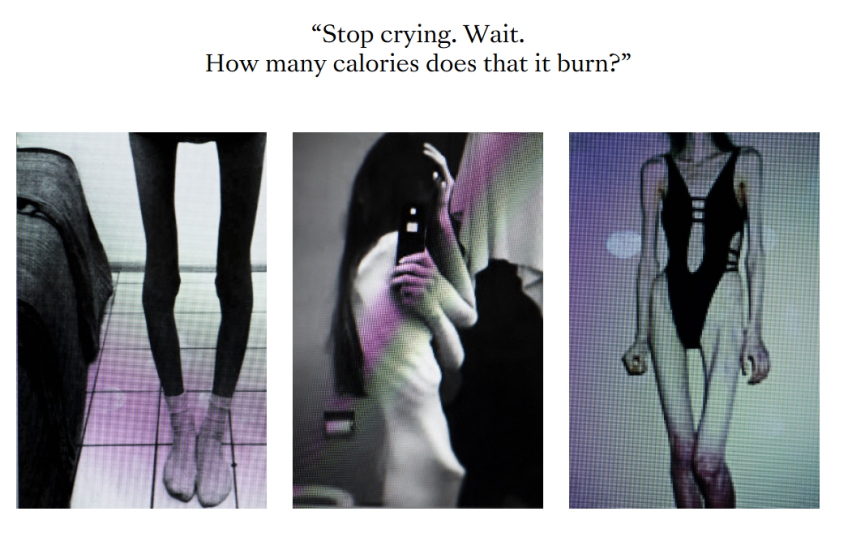
Image source: Laia Abril
Under this strange trend, Thinspo gradually combined with many pop culture elements on Tumblr, forming a new aesthetic including elements of rebellion, fashion, and coolness. Just like the current modification trends among Jirai Kei girls, pathological weight loss centered around Thinspo was a peculiar outlet for expression for that group of people.
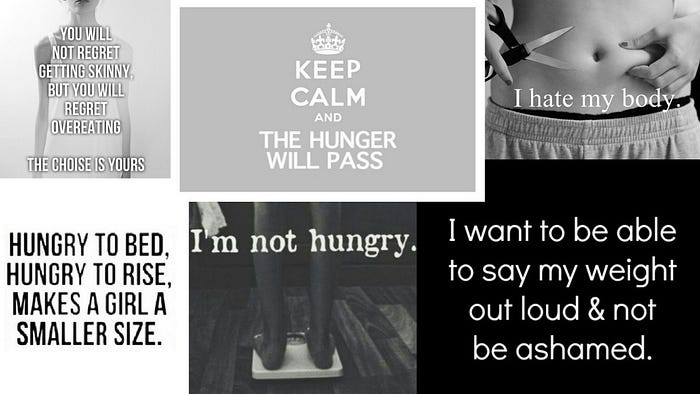
But obviously, allowing such views to spread will inevitably cause serious harm, especially since Thinspo affects a large number of teenagers. Thus, under the joint suppression of various social platforms, this unhealthy, even quite pathological trend, was temporarily suppressed—but only temporarily.
The current #SkinnyTok is very much like the resurgence of the Thinspo trend. Both regard thinness as beauty and trigger imitation during dissemination. The difference is that internet dissemination today is much faster than before, so the harm caused by such videos is likely to be even greater. Thinspo was limited to certain small groups, but #SkinnyTok has now become a hot topic on the international internet that cannot be ignored.
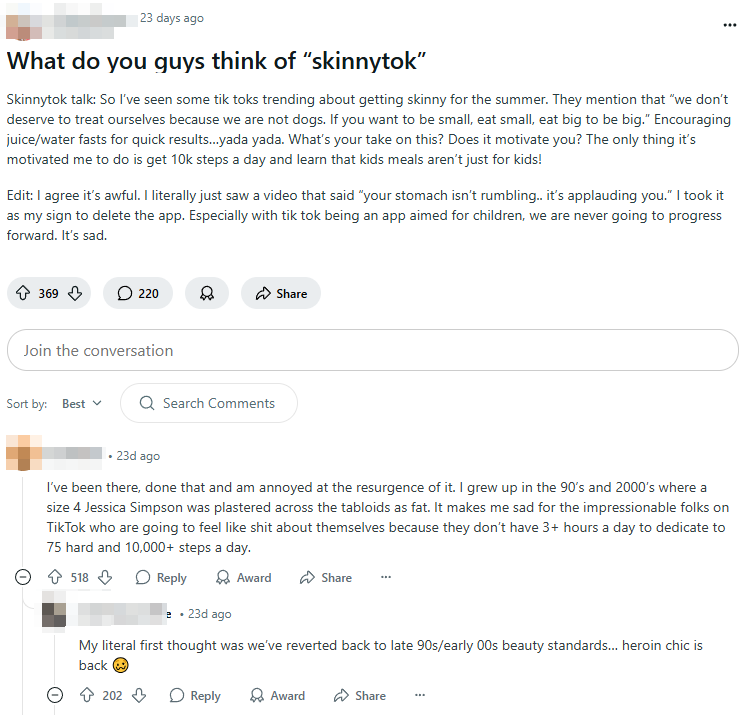
In fact, just a few days ago, Clara Chappaz, France's Minister Delegate for Digital Affairs, decided to submit the term #SkinnyTok to relevant EU departments, warning everyone about the dangers of this hot topic—"These videos promoting extreme thinness are repulsive and absolutely unacceptable."
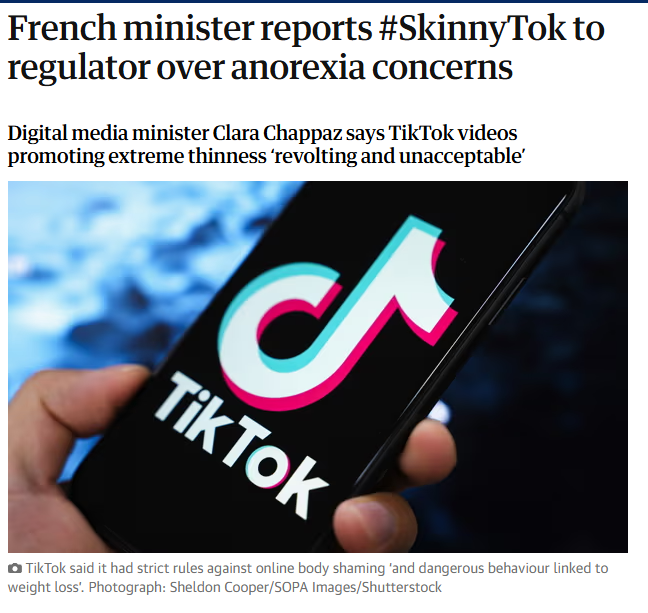
Currently, TikTok has removed a large number of extreme videos, retaining only some milder weight-loss record videos, accompanied by the gentle reminder "You are more than your weight." Perhaps we can say that this incident will temporarily come to an end online.

But let's delve deeper: What is the root cause of this trend's continuous spread and the large number of imitators? I believe it is the anxiety generated by forcibly binding words like "thin" with "healthy" and "beautiful"—only by becoming thin can one be praised. In the current era of short video popularity and powerful recommendation algorithms, this anxiety is artificially created on platforms, ultimately causing the former Thinspo trend to make a comeback.
Therefore, through the popularity of the #SkinnyTok hashtag and the resurgence of the Thinspo trend, the issue we need to pay more attention to now is the more severe creation and spread of anxiety brought by the short video era. In the past, centralized advertising created anxiety to stimulate consumer desire; now, it has evolved into a decentralized model where countless video bloggers spread anxiety to gain more direct or indirect benefits. Under the inducement of many relatively authoritative top bloggers (i.e., the #SkinnyTok advocates promoting successful weight loss), some people indeed believe in the authority effect that what they say is true. Phrases like "Thin, but not thin enough" and "If you want to lose weight, eat less; if you want to gain weight, eat more" may have been or are already regarded as golden rules, harming more people.
It must be said that such cases are not rare. For instance, the recent CCTV report on the investigation into "AI-generated fake miracle doctors" shows how such videos spread wildly on the internet. Although the images are AI-generated, they can still deceive those with insufficient discernment skills. By promoting "medicine can cure diseases" to alleviate anxiety, coupled with fabricated identities as "intangible cultural heritage inheritors" and a vast number of accounts, it is easy for middle-aged and elderly people unfamiliar with the internet environment to fall victim.
It can only be said that the elderly follow AI miracle doctors to eat what they shouldn't, while the young follow weight-loss advocates to not eat what they should. Everyone has a bright future ahead.

Of course, this is not to say that technology is guilty. However, under increasingly powerful technological conditions, the spread of anxiety targeting those with poor discernment skills becomes harder to prevent. Poor discernment here is not related to gender or age; anyone can be deceived if it is not in their familiar field. Therefore, in this situation, both platform regulation and technological control should be stricter. Otherwise, every future internet user will suffer.
Returning to #SkinnyTok, although the original intention of losing weight is good, the increasingly extreme and exaggerated video content fills viewers' minds with anxiety, ultimately leading more people to pursue a pathological "thinness" in extreme ways, moving further away from health. But in reality, those promoting #SkinnyTok might not be healthy themselves. On Reddit, several well-known bloggers who advocate "losing weight for health" have been exposed as suffering from various illnesses despite their slogans. After all, no matter how good your physical condition is, if you follow this lifestyle for a while, problems are likely to arise.
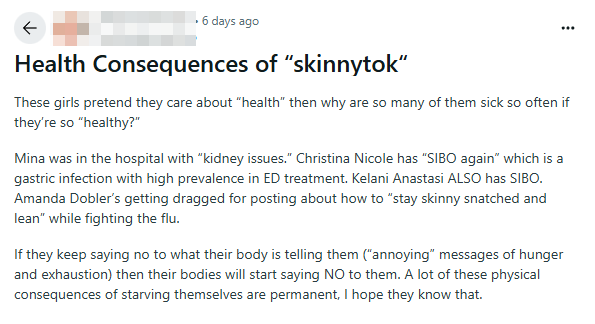
Perhaps, by learning the lifestyle from #SkinnyTok, people get sick; by learning to spread anxiety from #SkinnyTok, the internet gets sick.