

As everyone knows, in Paradox Interactive's simulation games that emphasize "historical accuracy" (or wildly altered timelines), the great Eastern power has always been a difficult entity to balance—because ancient China was simply too overpowered.
In Europa Universalis, the Ming Dynasty starts as the world's strongest power. In Victoria, once the Qing Dynasty completes modernization, it shoots straight to the top of the great powers. And in Crusader Kings, China at its peak is terrifying. Due to its massive scale and administrative mechanisms vastly different from Western European feudalism, the previous game, Crusader Kings II, had to use a workaround by setting the Celestial Empire as a special interactive menu. Players could only accumulate "Imperial Favor" through tribute and audiences, using it to arrange imperial marriages, obtain imperial treasures, or even summon heavenly troops to unleash the "Imperial Favor Earth-Shattering Punch" on enemy nations...
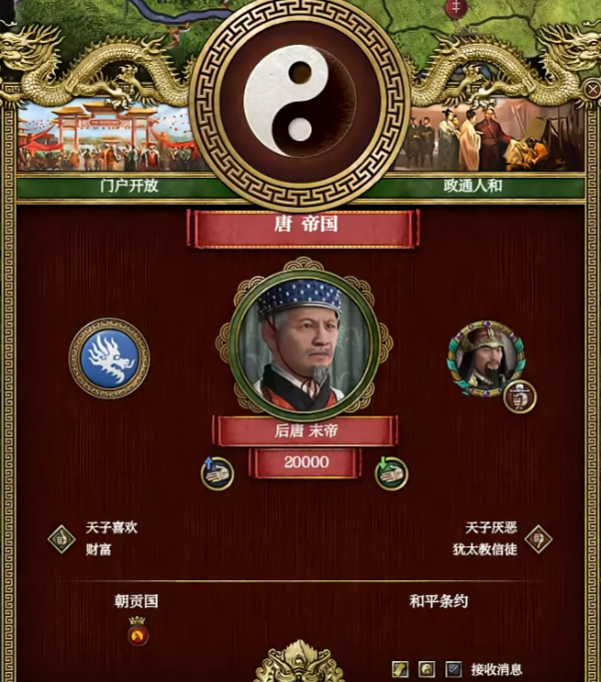
However, a Celestial Empire that exists only in menus is not what Chinese players want to see. As the veteran leader in the strategy simulation genre, if Paradox Interactive fails to deliver a good Celestial Empire experience, it's hard to expect other developers to do better.
Fortunately, earlier this year, Paradox Interactive officially announced the Eastern Regions DLC for Crusader Kings III, titled "Under Heaven." This will be the largest expansion pack for Crusader Kings III to date. It's not just a simple map expansion; it will also introduce a complete Celestial Empire government type, featuring mechanics such as the Imperial Examination system, political factions, and aristocratic clans—elements that sound like they belong in "Ming Dynasty 1566."
During the recent Tokyo Game Show, we were invited by Paradox Interactive to personally experience the beta version of "Under Heaven." Let me tell you, it perfectly matched all my imaginings of the intense competition among scholars in the ancient Celestial Empire.
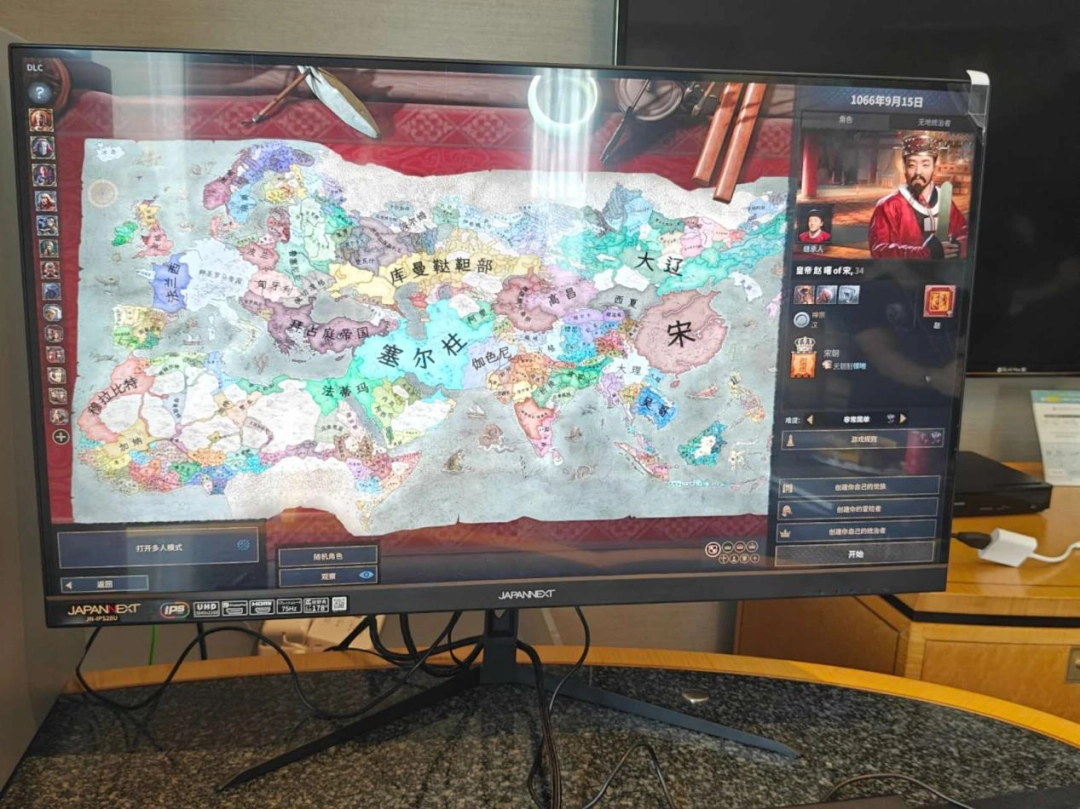
Unlike medieval Europe, where everyone seems to have their own partition law and eight sons fighting over a single county inheritance, the Celestial Empire governs through virtue. In plain terms, except for the Emperor whose position is hereditary, all local official positions—from prefects to magistrates—are appointed by superiors. The way to obtain these appointments is by increasing your "Virtue Rank" (somewhat similar to legitimacy in Western Europe) and becoming a "person of virtue."
However, the concept of being "virtuous" is vague and subjective; everyone claims to be virtuous in their own way. How do you prove your "virtue"? You need something tangible. The most powerful proof is through the primary method of entering officialdom in ancient China—the Imperial Examination system.
Suppose you play as a young descendant of a scholarly clan, aiming to follow the path of self-cultivation, family regulation, state governance, and bringing peace to the world. From the moment you understand things, you must study intensely, rigorously learning Confucian classics to fully enhance attributes like Learning, Military, and Diplomacy, thereby topping the "Children's Examination" aimed at child students. Upon reaching adulthood, you must participate in provincial examinations held by local governments, metropolitan examinations organized by the central government, and finally the palace examination reserved for the top ten candidates from the metropolitan exam, in order to obtain academic degrees.

Each time you pass an imperial examination, you unlock a higher "Virtue" rank cap. By default, your "Virtue" rank cap is locked at the eighth grade. "Virtue" is divided into ten levels, ranging from the lowest "Unranked" to the highest "First Grade." Only by reaching the corresponding Virtue rank can you be appointed to the respective official position.
In other words, if you're an uneducated peasant your whole life, even if your virtue is so profound it moves heaven and earth, causing snow to fall in June, the court officials will merely remark, "The Emperor is virtuous," without giving you any real respect. Only by proving your worth through the imperial examinations will the court acknowledge your "virtue."
However, achieving academic success is no easy feat. Besides diligently studying the Confucian classics, you can choose to cheat in the exams or bribe examiners. If you're sharp enough, deceiving everyone isn't difficult. Of course, if you're unfortunately caught cheating, you're in trouble. Depending on the situation, you might be arrested on the spot, becoming a KPI metric for the examiner to prove their "integrity and virtue" (catching cheaters counts as administrative achievement), or you might be heavily extorted by the examiner in various ways... But considering the numerous benefits of success, people are still willing to take the risk.
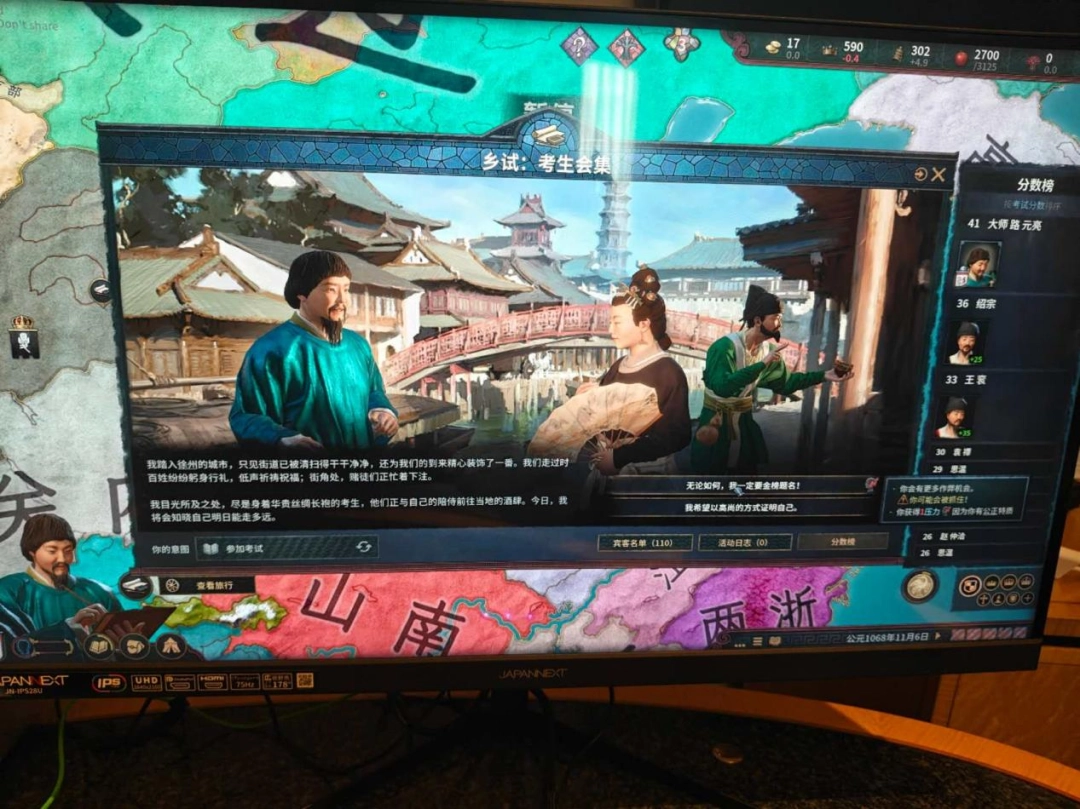
Once your name appears on the golden list of successful candidates, it will be added to the roster of officials awaiting appointment. If someone ahead of you retires, the top candidate on the waiting list will be appointed to the position, allowing you to officially become a civil servant of the Great Song.
Once you become a local official, you'll first notice a new icon labeled "State Treasury" next to the money section in the UI menu. The taxes you collect and budgets allocated from above will first go into the state treasury. When hiring "Cabinet" members, you can use these public funds to pay salaries, and you can also use public funds for certain construction projects. However, if you want to renovate your family's scholarly estate or host banquets to curry favor with factions, you must use your personal wealth.

By default, you can freely transfer personal wealth into the state treasury, but not vice versa... However, there are always exceptions. If you possess personality traits like "Greedy," you might be able to embezzle state funds for personal gain? Unfortunately, I created a Song Dynasty version of Hai Rui for this playthrough, so such deeds were out of the question.
During local governance, random events such as corruption among local officials, senility of superiors, or natural disasters affecting villages will occasionally occur. As a governor, you often need to travel locally to handle these major issues personally. If handled properly, these events become part of your administrative achievements, accumulating virtue and helping you advance more easily in your career. Of course, this is just the main path of officialdom, not a shortcut. To thrive in bureaucracy, you must learn to blend in and navigate the complexities gracefully.
The first step is to find a "mentor." You can search for a good teacher at events like philosophical debates held in various locations. If you manage to apprentice under a highly respected and favored mentor, they can provide considerable assistance during your ups and downs in officialdom.
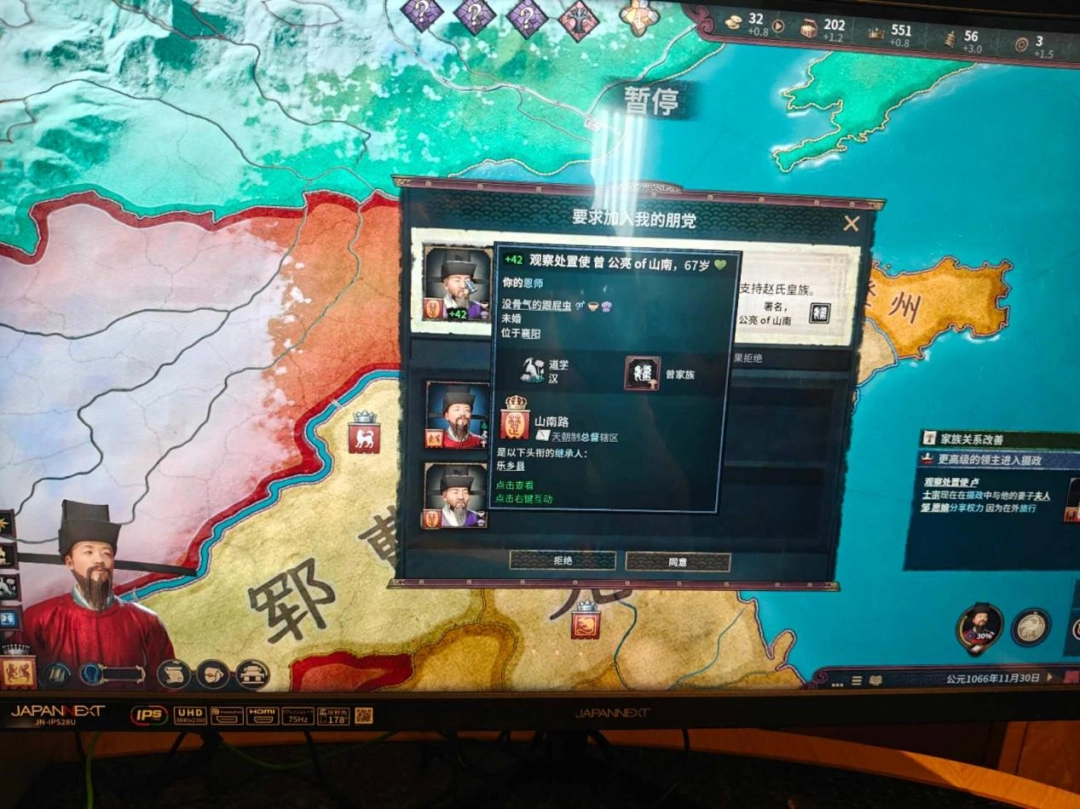
The second step is to join a "faction." You can spend influence to join different factions such as the "Loyalist Faction," "Anti-Barbarian Faction," "Progressive Faction," or "Conservative Faction." However, if you accumulate achievements and build a reputation in your official career, various factions will compete to recruit you. Even if you've already joined one faction, members of other factions may occasionally try to poach you.
Each faction has its own platform and provides various bonuses. For example, the "Loyalist Faction's" platform is to be a devoted student of the Son of Heaven and the Emperor's close confidant. This makes it easier to gain the Emperor's favor but reduces your limit on private troops, making it harder to break free from superior control. The "Anti-Barbarian Faction" leans towards external conquests, the "Progressive Faction" gains more opportunities for reform, while the "Conservative Faction" appears to consist of stubborn traditionalists who revere the ancient sage-kings Yao, Shun, Yu, and Tang...
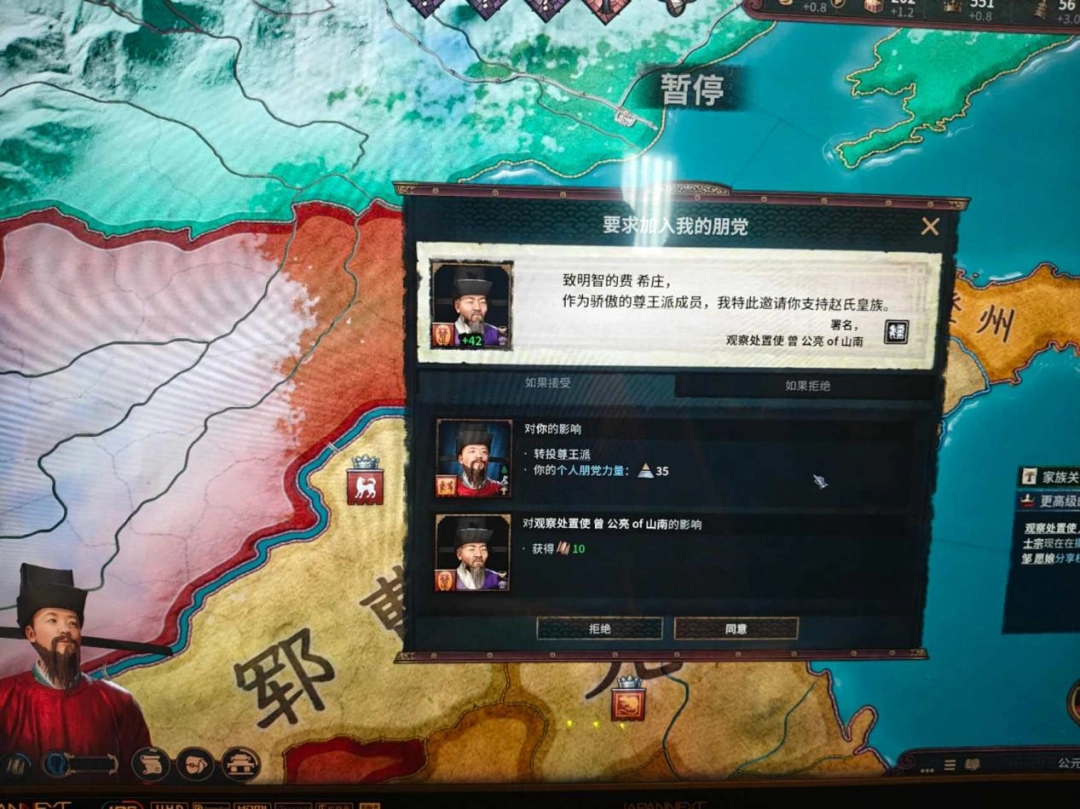
The Emperor will have his favored and despised factions. The power of these factions will shift depending on the evolutionary stage of the Celestial Empire government. During times of "harmonious governance," the court may lean towards respecting the monarch and maintaining the status quo. However, when the dynasty is on the brink of collapse, people's hearts will turn towards change. As a subject, your task is to climb the ladder by leveraging factions while remaining vigilant, knowing when to retreat, and adapting flexibly to the changing political situation.
Although the limited demo time prevented me from fully experiencing the actual impact of each faction on the balance of power, these rich options promise to fill the celestial court's political landscape with unknown variables.
As you accumulate enough achievements in your official career, your name will appear more frequently on lists for filling vacant positions across various regions, increasing your chances of promotion. At the same time, you can leverage your influence within the bureaucracy to pull strings and forcibly boost your ranking on these lists. Eventually, however, you'll likely hit the "Virtue Rank Cap" corresponding to your current status, preventing further advancement. At this point, you must make a choice: resign from your post to take the next metropolitan examination in hopes of achieving a higher degree, give up the opportunity to consolidate your current position, or secure a better starting point for the next generation... We believe that when the DLC officially launches, every player will find their own path to serving as an official.
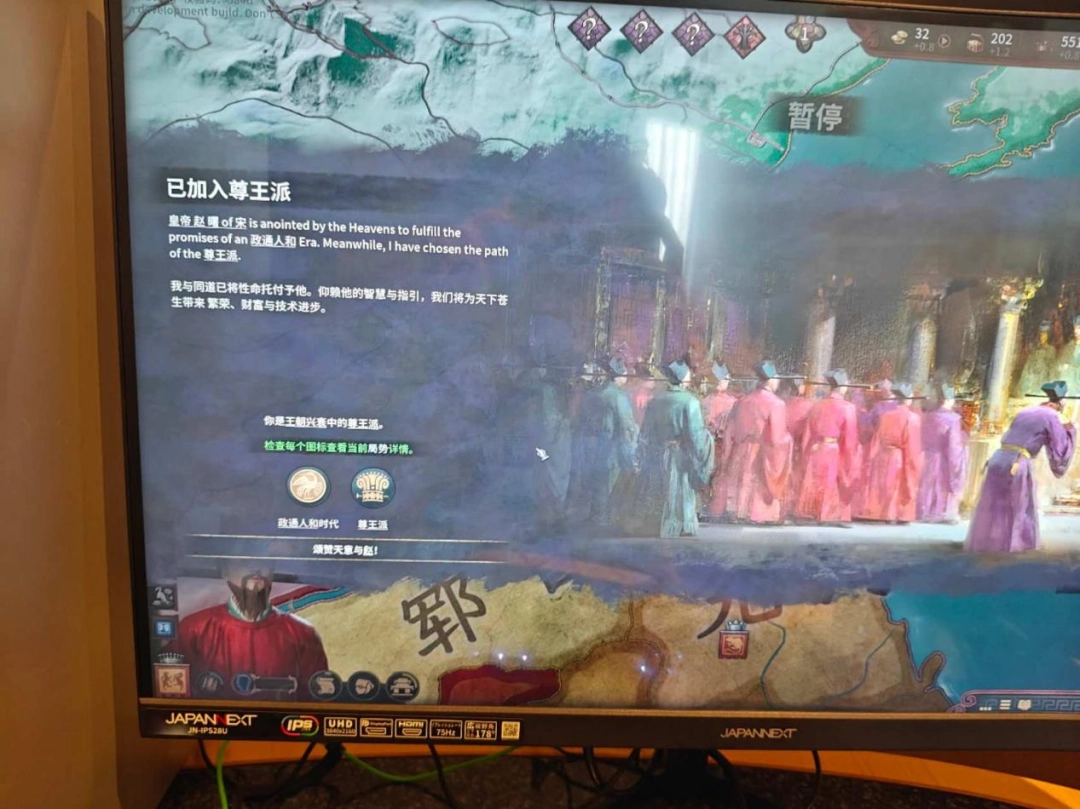
It's worth noting that Everythinggj mentioned above is based solely on about an hour of gameplay starting as a "scholarly clan member." The experiences of playing as the Emperor, a high-ranking local official, a landless adventurer, a warlord in chaotic times, or rulers of neighboring countries like Japan, Korea, or the Liao Dynasty would surely differ significantly from this demo... It's a pity the demo time was too short for me to experience them all.
It should be noted that the current version still has several significant shortcomings. First, localization is still ongoing, although the translation quality of proper nouns and sentences seems quite satisfactory so far. Second, Crusader Kings III's signature "Focus" system doesn't seem to be well-adapted for "Under Heaven" yet. While the Diplomacy focus tree includes skills that "increase weight for official appointment queues," the Learning focus tree lacks skills like "enhance imperial examination performance," which is slightly regrettable.
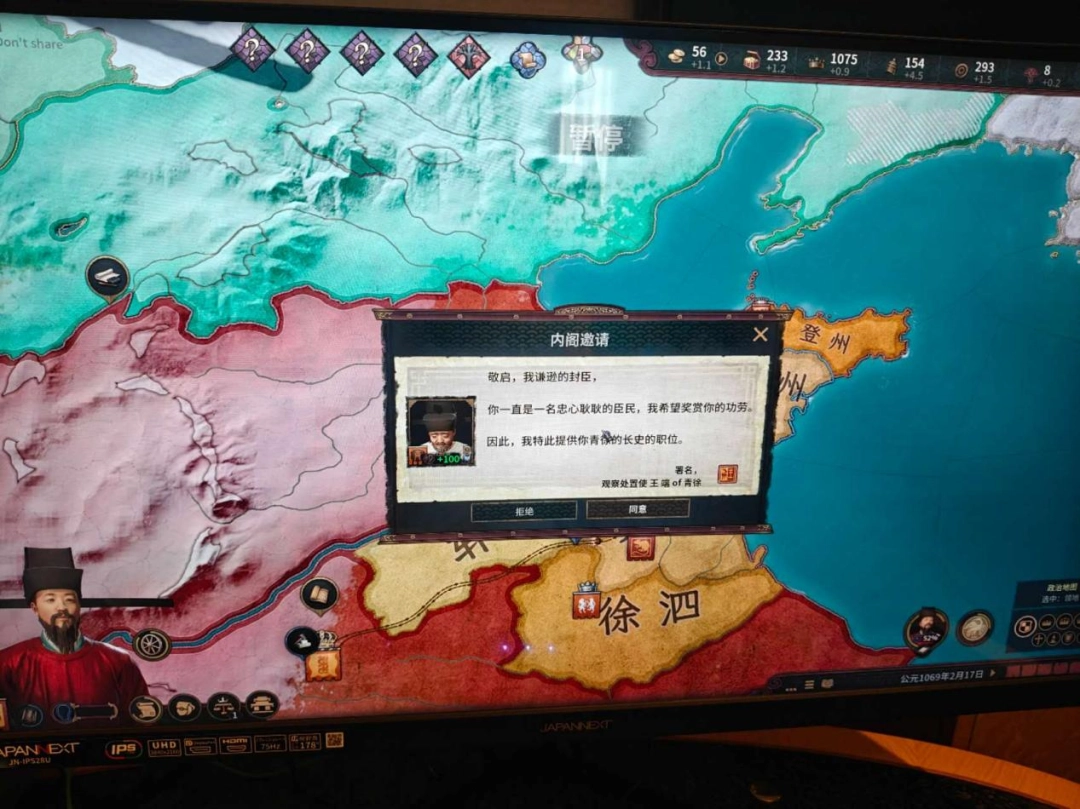
Overall, however, Crusader Kings III: Under Heaven has established a complex and interesting framework for simulating Eastern dynasties. Honestly, it might become the best "Great Song Dynasty 1066 Simulator" on the market.