

Jakub Knapik and Kacper Niepokulczycki, two art directors at CD Projekt RED, recently shared insights into the creation of Night City in "Cyberpunk 2077." The city was almost entirely hand-crafted by the team, with procedural tools used only as starting points in limited cases.

From buildings, billboards, and trash cans to individual sheets of paper on sidewalks, numerous elements in the city were manually processed. Knapik stated that the team wanted Night City to be more than just a backdrop for gameplay; they aimed to create a place where players would want to drive around, listen to music, complete side quests, buy apartments, and linger, resembling another life sandbox within the cyberpunk world.
Night City's visual system is built upon four distinct era styles, including 1980s retro cyberpunk, 1960s plastic kitsch, corporate neo-militarism, and仿生 neo-kitsch aimed at the ultra-wealthy. The team also uses contrast as a key design principle, creating a sense of conflict through architecture, environmental storytelling, and landscapes. For example, in Coronado Farm, a house has an AV crashed into its roof; while residents are accustomed to it, players perceive it as an abnormal sight.
Each district also has its own history and color rules. Map design unfolds layer by layer based on era, community, corporation, and theme. Japantown stems from the expansion of Japanese corporations, while the coastal area's appearance is tied to industrial warehouses and ports.
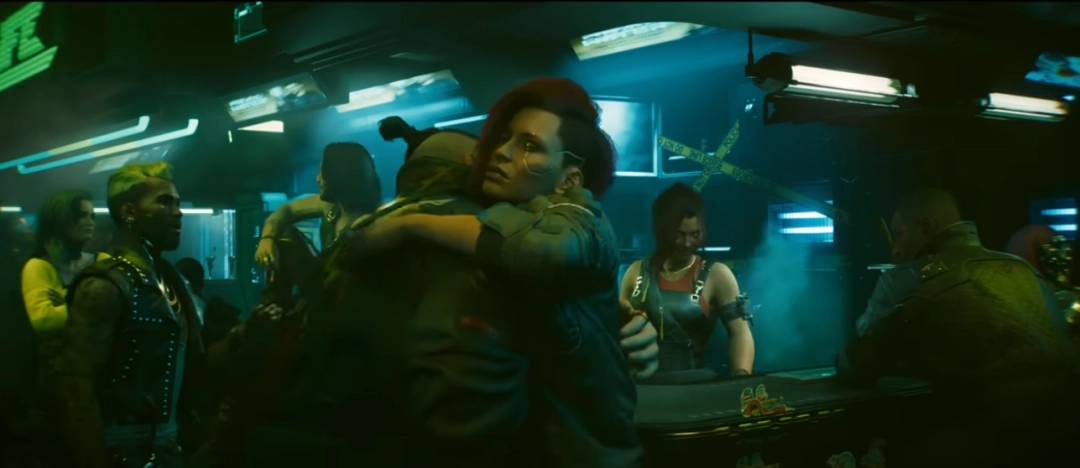
The team acknowledged that certain areas in the base game had overly dense advertisements, neon lights, and environmental details, creating visual noise. During the development of "Cyberpunk 2077: Phantom Liberty," the art team established new rules for color and shape combinations as well as the use of negative space. As a result, although Dogtown features more details, it appears less cluttered.
The first-person perspective also changed level scale, object density, and building proportions. The texel density in "Cyberpunk 2077" is twice that of "The Witcher 3: Wild Hunt"; scenes previously presented through cutscenes have become environments where players can move and interact with objects, requiring fully constructed 360-degree spaces. The team also used familiar objects like papers, bottles, and benches to help players gauge the scale of surrounding buildings.
Knapik stated that the studio questions the reasoning behind every design decision and continuously seeks its own unique style. This approach requires longer development time but helps avoid common tropes. "The Witcher 3: Wild Hunt" and "Cyberpunk 2077" adopted this philosophy, and the studio's new projects will continue to follow the same practice.